

Britain’s largest prison hunger strike in decades has unfolded with surprisingly little public scrutiny
In British prisons this winter, pro-Palestinian activists linked to Palestine Action have pushed their bodies to the brink of death. By early January, most of the original seven participants had called off their hunger strikes, but three have persisted.
The Palestine Action-linked protest is the largest coordinated prison hunger strike in the UK in over four decades. Yet for much of its duration, it has barely registered as a national story.
A wave of arrests after terrorist label
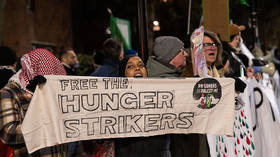
The hunger strike grew out of a crackdown on Palestine Action after the UK government formally classified the group as a terrorist organization in July 2025. Under Britain’s Terrorism Act 2000, such a designation made even expressing support for the group a criminal offense, punishable by years in prison.
The move triggered a wave of bizarre arrests at demonstrations and public gatherings, with police detaining people for holding placards, chanting slogans, or displaying messages deemed supportive of the group. Elderly protesters were among those taken into custody, drawing criticism from civil-liberties groups and human rights organizations. Across Britain, performances or exhibitions by artists were cancelled or threatened with legal action for declaring their solidarity with the people of Palestine, despite the UN citing “genocide”in Gaza.
Amnesty International and UN human-rights experts condemned the crackdown as disproportionate, warning that terrorism legislation was being used to police political expression and protest. Critics said the classification blurred the line between militant extremism and domestic activism, sharply expanding the reach of Britain’s security laws.
Who are the hunger strikers?
It was against this backdrop of arrests, restrictions and prolonged pre-trial detention that a group of Palestine Action-linked detainees, arrested over direct action protests but left for months in limbo, turned to the last tool left to them: a coordinated hunger strike.
Heba Muraisi, 31, has been on full hunger strike for over 70 days at New Hall Prison. She was arrested over alleged involvement in a protest at Israeli military contractor Elbit Systems’ UK plant, which prosecutors allege caused almost $2 million in damage. In custody since June 2025, she reportedly has severe breathing difficulties and muscle spasms, according to reports.
Kamran Ahmed, 28, has been on full hunger strike for over 63 days at Pentonville Prison. He has been hospitalized multiple times for heart complications and has reportedly lost 16kg.
Lewie Chiaramello has been on intermittent hunger strike (fasting every other day) due to Type 1 diabetes. Umar Khalid, 22, is reportedly restarting his hunger strike in early 2026.
A protest born in detention
The hunger strike began on November 2, 2025, coinciding with the anniversary of the Balfour Declaration. All three current hunger-strikers have been held at length in pre-trial limbo, and supporters argue that the detention has stretched into punishment. One major report described the remaining strikers as having spent more than 18 months behind bars without trial, which goes far beyond the usual custody time limit for pre-trial detention.
The strike formed around specific demands: bail and timely trials, reversal of the terrorist organization characterization, relief from prison restrictions on communication, and closure of Elbit’s UK facilities.
The slow violence of starvation
Doctors and monitors have described the strike entering a “critical phase”in December 2025, citing severe deterioration after prolonged refusal of food. Reporting has mentioned hospital admissions and worsening symptoms among those continuing, including breathing problems and signs of neurological strain, with possible sudden collapse risk.
A national protest and delayed recognition
What has distinguished this strike is not only its severity but the muted attention it received while it has been unfolding.
UN experts have urged the UK to protect the detainees’ lives and rights. Prominent figures and campaigners have escalated public warnings, while legal and medical voices have raised alarms about the ethics of state responsibility once a prisoner’s health enters critical decline.
Even then, the dominant narrative in broader British circulation has often centered on medical jeopardy more than the underlying dispute: prolonged detention, conditions therein and the political consequences of the terrorism classification. The protest has been presented primarily as a humanitarian emergency, and less a matter of state legitimacy.
A protest that challenges the information order
Hunger strikes are designed to force a public reckoning. Their leverage comes from visibility: the state holds the body and the public is meant to judge.
The LSE analysis suggested that coverage was limited because Palestine, counter-terrorism laws, and state security are treated as high-risk topics in British journalism, where editors tend to tow the state line.
Silence and narrow angling reduce that risk but also reduces the striker’s only real leverage.
What happens next?
If serious harm or death occurs, it won’t only raise questions about British prison policy and practices, but also raise an ugly media question: did Britain’s mainstream press “discover” the story only when bodies became unavoidable?

